Synkroniciti is thrilled to welcome back writer Tim Collyer of Wiltshire with “The Physics of Fat,” an experimental short story that dissects how body shaming is embedded in the art of dance—how “aesthetics” calcify into an atmosphere of surveillance, diminishment, and the relentless policing of bodies. Performing arts institutions cling to a narrow ideal so fiercely that they lose sight of the beauty and power of those who fall outside that sanctioned silhouette.
“They’ve told me to move smaller. The Harlequin floor has a nick from a dropped light; I set my toe to it like a compass point. The costume mistress called my body “challenging.” She said the same about my girlfriend.
[Margin note: F = m·a. Maintain objectivity.]
The choreographer taps his pencil. “Precision, please. Think petite.””
What makes this story so arresting is the way Collyer interrupts the rehearsal with margin notes—square‑bracketed formulas and observations that provide a counter‑narrative. These notes refuse the emotional gaslighting of the studio. They support the truth: the dancer is not transgressing the laws of physics; the institution is failing humanity. Like our narrator, these notes fail to stay in the margins. When they weave into the body of the text, we are forced, along with the rehearsal personnel, to confront prejudice masquerading as “technique.”
This confrontation is punished, of course. Systems built on shame rarely tolerate clarity. But before the hammer falls, Collyer gives his dancer a glorious moment of reclamation.
“I take the solo I wasn’t given. Not the whole thing—just the space between seven and eight when no one’s watching. I make that space a country. Breath. Loud on purpose. Tender: I’m my own partner. The room’s breath catches. The pencil drops.
[Margin note: Observation: celestial mechanics initiating.]
I inscribe an orbit with my heel, wide as a promise. I drop—wrong for half a second—find the angle, the earth’s pull. A fall mapped to land where bruises don’t bloom. For three seconds I am warm. What’s dangerous is how right it feels.”
In those three seconds, she takes up her own force, her own trajectory. Collyer reminds us that the body deemed “too much” is often the one capable of revealing the most truth. And that claiming one’s space, even for a breath, is an act of radical, embodied defiance.
Performing arts organizations often lament that audiences have grown cold. Perhaps the coldness is not a mystery but consequence. A stage that polices its performers teaches its audience what to value, what to fear, what to erase. And in that erasure, something essential dims. How many people don’t enter theaters because they have never been invited to imagine themselves there? How many have learned, quietly and early, that the miracle of their own gravity is unwelcome in places that claim to celebrate human motion?
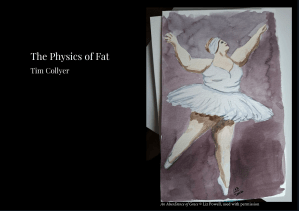
Read “The Physics of Fat” in Synkroniciti’s Audacity issue, Vol. 8, No. 1, available here: https://synkroniciti.com/the-magazine/purchase-individual-issues/.

Tim Collyer is a British short story writer and multiple Pushcart Prize nominee. His work won the International Flash 500 Prize and the Seán Ó Faoláin Short Story Competition, and has appeared in The Threepenny Review, Nebula, Clockhouse, Woodside Review, and Gently Mad Magazine, as well as the Bath Flash Fiction Anthology. His fiction has been recognised in over thirty international competitions and is known for its literary focus on memory, ethics, and the quiet pressures shaping ordinary lives. He lives in Wiltshire and writes literary and speculative fiction.